Enterprises spend millions on military-grade hardware - precision radar sensors, ultrasonic flow meters, and industrial PLCs. Yet, when the data reaches the cloud, it is often dumped into generic, out-of-the-box charting libraries. The result? A cognitive nightmare for the operators monitoring the system.
In industrial IoT, visualizing data is not just about plotting points on a grid. It is about domain context. A poorly configured chart doesn't just look bad; it masks critical anomalies, delays reaction times, and leads to expensive physical damage - like undetected floods or equipment failure.
Here is why generic dashboards fail in telemetry, and how we engineer interfaces specifically for field operators.
The "Flatline" Illusion (Context-Aware Y-Axis)
The most common mistake in out-of-the-box charting tools is starting the Y-axis at zero. Imagine a river where the normal water level oscillates around 220 cm. If an anomaly causes a sudden 20 cm spike, the operator needs to spot it instantly.
However, if the chart's Y-axis is forced to start at 0, a 240 cm peak on a massive scale looks like a completely flat, safe line. To an algorithm, this is mathematically correct. To a hydrologist, this is a dangerous illusion.
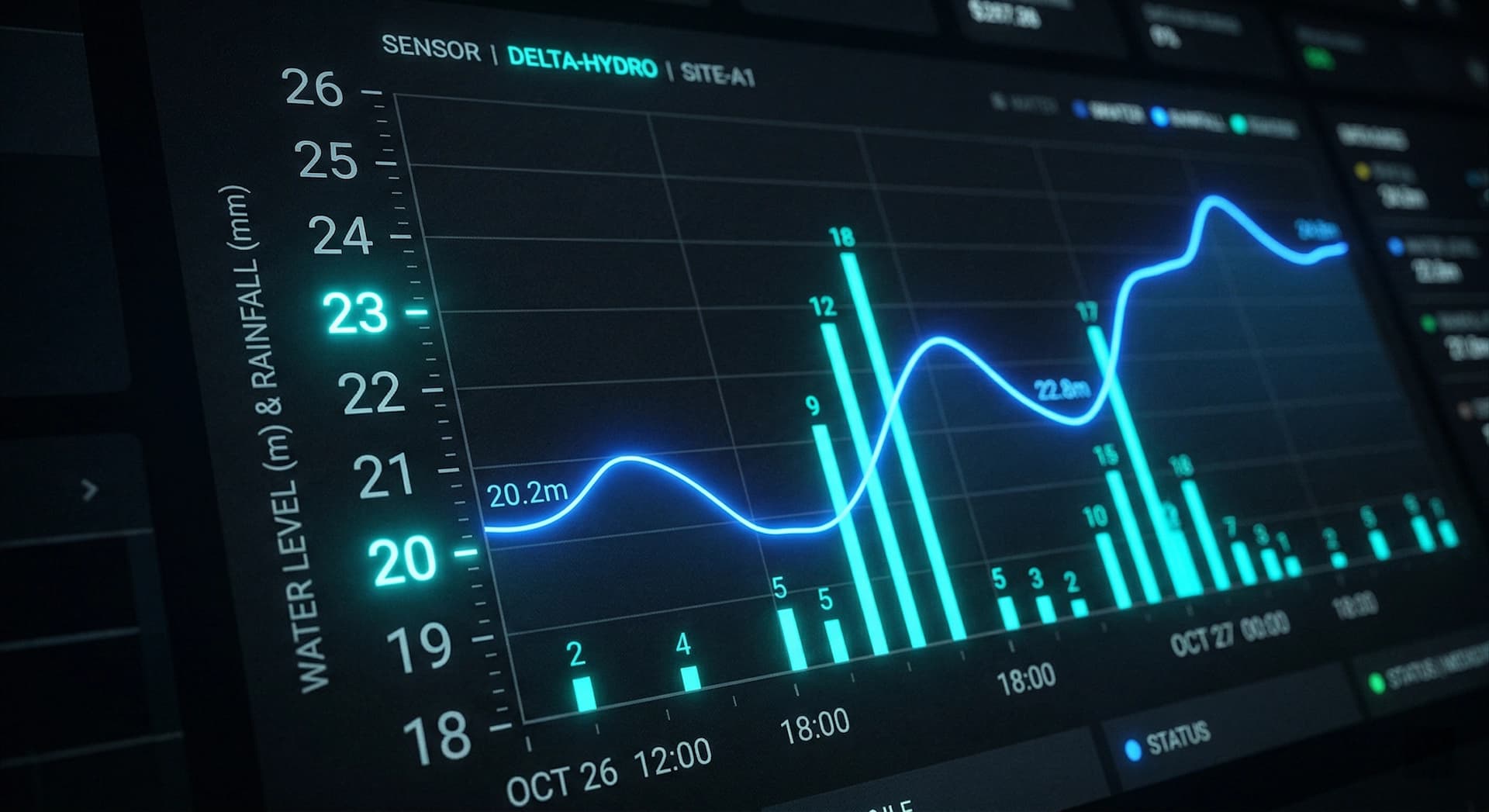
The Solution: we implement dynamic, context-aware scaling. If the data operates within a specific high-value threshold (e.g., 200–250 cm), the software automatically calculates a safe minimum bound and maximum bound. This amplifies the delta, making trends and anomalies immediately visible to the human eye without manual zooming.
Continuous vs. Accumulated Data
Another symptom of generic dashboards is treating all data types the same. Without deep domain context, it is tempting to default to line charts for every metric simply because it "looks clean." In the physical world, data behaves differently:
- Water Level / Temperature - continuous state. It flows and changes smoothly. It demands a Line or Spline chart.
- Rainfall / Power Consumption - accumulated event over a specific time bucket (e.g., "how much it rained in the last hour"). Plotting this as a line is fundamentally wrong. It demands a Column/Bar chart to represent volume.
Mixing these up forces the operator's brain to translate the visual back into reality. We eliminate this friction by mapping the UI component directly to the physical nature of the metric.
Multi-Axis Correlation (Reducing Cognitive Load)
Field engineers rarely look at metrics in isolation. They need to answer "Why?". Why is the water level rising? Because there was massive rainfall upstream two hours ago. To facilitate this, we build Multi-Axis Correlational Charts.
However, overlapping a line chart and a bar chart on the same grid creates chaos if not designed properly. The Golden Rule of Multi-Axis UI: the color of the data series must perfectly match the color of its corresponding Y-axis. If the water level line is blue, the left Y-axis text, gridlines, and ticks must be blue. If the rainfall bars are cyan, the right Y-axis must be cyan.
This entirely removes the cognitive load of matching legends to axes. The brain understands the relationship in milliseconds.
The Ultimate Escape Hatch
Finally, we must respect the domain experts. No matter how beautiful or interactive our web dashboard is, the Chief Hydrologist or Lead Agronomist has been analyzing data in Excel for 20 years. They have their own proprietary formulas and pivot tables.
A truly professional telemetry platform doesn't try to trap the user. It provides an "Escape Hatch" - a robust, instantly accessible "Export to CSV" button scoped to their exact date range and filter settings. Good engineering means knowing when to get out of the user's way.
Building telemetry platforms requires bridging the gap between raw database metrics and human perception. By designing domain-driven visualizations, we reduce operator fatigue, prevent human error, and ensure that the expensive hardware in the field actually delivers actionable intelligence.